
Element of literature
(b)Read Texts 1 and 2, then discuss in pairs or small groups the questions that follow after each text.
Elements of literature
There are two elements of literature – form and content. Simply, content is what the writer wants to say while form is how he or she says it. For example, in a novel, the elements of form are, firstly, the setting. This is the context, physical and social environment in which the story takes place. It is both geographical (where) and historical (when). For example. “Hawa the Bus Driver’’ has its setting in Dar es Salaam in the 1980s when people were mainly using UDA for transport and the daladala system of transport was beginning to take part. Setting also refers to social environment. Is it a time of peace or war? What are the traditions and beliefs of that society and so forth. The second element is the plot. This is the way the story is put together, how one event lends to or causes another event how characters interact with one another and so on. At the heart of any plot, there must be a conflict of some kind as that is what makes us want to continue reading. We want to know how the conflict is resolved.
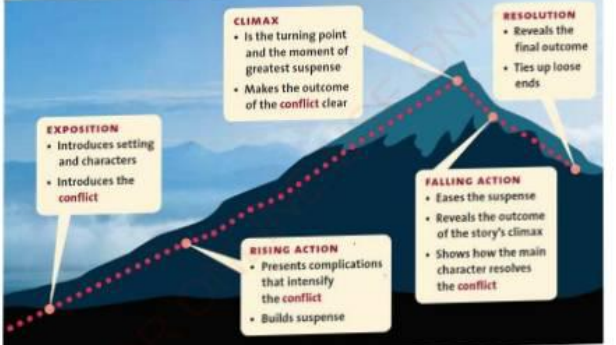
Conflict is always introduced at the beginning (exposition stage) and as the characters attempt to resolve the conflict, it becomes complicated and the plot thickens at each stage. Thus, the plot has the following stages or elements which arc also summarised in the following diagram.
(a) Exposition: This is where the writer or author introduces the characters and setting by providing their descriptions and background. It is when, the conflict is introduced as well.
(b) Rising action: This is built during the story and gets more exciting It is where conflict gels stronger and stronger. It is also where the suspense gets
stronger as we want to know how the conflict is resolved.
(c) Climax: This is the moment of greatest tension or excitement in the story. It is when the conflict reaches its highest point and begins to be resolved.
(d)Falling action: This happens as a result of climax and we know that the story will soon end. It is often very short.
(e) Denouncement (resolution): This is the stage where all the challenges and conflicts are resolved and the story ends.
The third element is the characters. These are the imaginary people, animals or objects the writer has created for the story. We learn about the characters in many ways; their names and appearance, their education and work, the way they dress and talk ,their ideas and their actions, the problems they face and the ways they deal with them and what they learn as the story continues. Characterisation refers to the author’s ability to create characters that are realistic and make us feel about them; to lave them, or hate them , support them or want them to fail. The way we feel about the character is another reason for us wanting to read the novel. The fourth element is Ianguage. This refers to words the writer chooses and uses in describing or in telling the story, and how the author uses different figures of speech to make the language more attractive. It also refers to dialogue; the way he or she makes the characters come alive by the way they talk. The fifth element is style of the writer. This refers to the way the writer put the whole text together, including the language used, characters and his or her own unique way of telling the story.
there are also other smaller elements of style such as title. The writer tries to choose the title which attracts readers lo read and say something about what they will find inside the book or poem.