
Structure of pines
Observing the reproductive structures of pines
Materials
Branches of pine tree with male and female cones
Procedure
- Carefully examine the branch of a pine tree and identify the male cones which are relatively small and more herbaceous. Normally male cones occur in clusters at the axis of lower branches.
- Carefully examine the features of a pine tree and identify the female cones which are relatively larger and woody.
- Draw well labelled diagrams of male and female cones
- Discuss the findings with your classmates
Questions
(a) What differences did you observe between the male and female cones?
(b) Apart from male and female cones what other features have you observed?
Pines are the conifers which have needle-shaped leaves, thick and scaly bark, and are evergreen. They are among the most familiar coniferous trees which can thrive in temperature and tropical regions. The conifers live longer than other trees. Structurally , pines are made up of roots, stem and leaves. The stem of most pines is thick and scaly but some species have a thin bark and they produce several branches that appear in whorls. The centre of the stem is called pith. It is made up of several concentric rings called annual rings. These rings help the plants to undergo secondary thickening.
Pines have green needle-shaped leaves, that can carry out photosynthesis. The leaves of pine are clustered into a short shoot in which adjacent internodes are very short. This type of leaves which occur as a clustered short shoot are called a fascicle. The cone is the reproductive part of pines which contain female cones that produce pollen that is transferred by the wind female cones. The female cones have the ovules that contain the female gamete. When pollen lands on the female cone,, it develops a pollen tube that introduces the male nuclei into the ovule and fertilisation occurs. The male cones are relatively soft, herbaceous, and small while female cones are woody, and relatively larger as seen in figure 1.3 and 1.4

Figure 1.3: Male cones
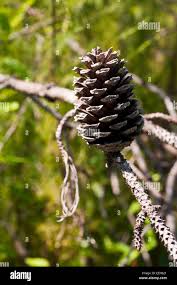
Figure 1.4: Female cones