(b)Read Texts 1 and 2, then discuss in pairs or small groups the questions that follow after each text.
Text 1:
There are two elements of literature – form and content. Simply, content is what the writer wants to say while form is how he or she says it. For example, in a novel, the elements of form are, firstly, the setting. This is the context, physical and social environment in which the story takes place. It is both geographical (where) and historical (when). For example. “Hawa the Bus Driver’’ has its setting in Dar es Salaam in the 1980s when people were mainly using UDA for transport and the daladala system of transport was beginning to take part. Setting also refers to social environment. Is it a time of peace or war? What are the traditions and beliefs of that society and so forth. The second element is the plot. This is the way the story is put together, how one event lends to or causes another event how characters interact with one another and so on. At the heart of any plot, there must be a conflict of some kind as that is what makes us want to continue reading. We want to know how the conflict is resolved.
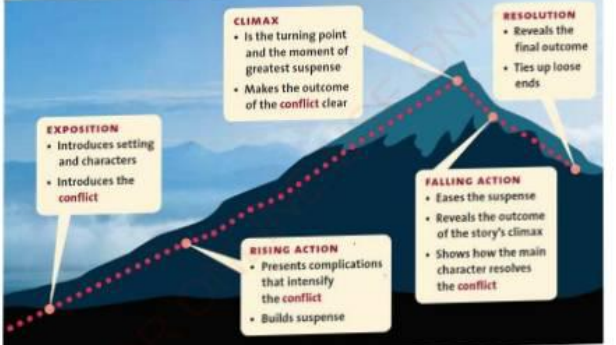
Conflict is always introduced at the beginning (exposition stage) and as the characters attempt to resolve the conflict, it becomes complicated and the plot thickens at each stage. Thus, the plot has the following stages or elements which arc also summarised in the following diagram.
(a) Exposition: This is where the writer or author introduces the characters and setting by providing their descriptions and background. It is when, the conflict is introduced as well.
(b) Rising action: This is built during the story and gets more exciting It is where conflict gels stronger and stronger. It is also where the suspense gets
stronger as we want to know how the conflict is resolved.
(c) Climax: This is the moment of greatest tension or excitement in the story. It is when the conflict reaches its highest point and begins to be resolved.
(d)Falling action: This happens as a result of climax and we know that the story will soon end. It is often very short.
(e) Denouncement (resolution): This is the stage where all the challenges and conflicts are resolved and the story ends.
The third element is the characters. These are the imaginary people, animals or objects the writer has created for the story. We learn about the characters in many ways; their names and appearance, their education and work, the way they dress and talk ,their ideas and their actions, the problems they face and the ways they deal with them and what they learn as the story continues. Characterisation refers to the author’s ability to create characters that are realistic and make us feel about them; to lave them, or hate them , support them or want them to fail. The way we feel about the character is another reason for us wanting to read the novel. The fourth element is Ianguage. This refers to words the writer chooses and uses in describing or in telling the story, and how the author uses different figures of speech to make the language more attractive. It also refers to dialogue; the way he or she makes the characters come alive by the way they talk. The fifth element is style of the writer. This refers to the way the writer put the whole text together, including the language used, characters and his or her own unique way of telling the story.
there are also other smaller elements of style such as title. The writer tries to choose the title which attracts readers lo read and say something about what they will find inside the book or poem
Text 2
Content, on the other hand, refers to what the writer is saying through his or her descriptions and characterisation. It contains four elements. The first element is theme. There is the main theme which is the central idea or issue portrayed by the piece of writing.
For example, in “Passed Like a Shadow,” the main theme is HIV and AIDS while in
“Unanswered cries.” the main theme is Female Genital Mutilation/Cutting (FGM/C). There
can also be sub-themes like the issues of how to bring up children in “Unanswered Cries ”.
The second element is conflict. As said above, conflict is the basis of the story. Without conflict there is no plot. There are many different kinds of conflicts. They include the following:
(a)Intrapersonal conflict (conflict inside a character, n dilemma the character faces,
conflict between their head and heart)
(b)Interpersonal conflict (conflict between characters It could be the main character
and another character or between two other characters)
(c)Social conflict (conflict between the character and society, or between groups in
society, war)
(d)Family conflict (conflict within the family)
(e)Cultural conflict (conflict between different cultures or between a character and the
culture, for example, Olabisi in ‘Unanswered Cries” goes against the culture of her
mother’s society )
(f)Political conflict (conflicts between political groups or parties, conflicts about different
ways of developing the country, etc ). For example, the conflict in the novel “Passed
Like a Shadow by Benard Mapalala includes the following:
i) Adyeri fell ashamed of himself as he listened to the song al school. This is an intrapersonal conflict. The same is true of Abooki after she was raped by John. She was affected psychologically because she lost her virginity even though it was not her fault.
ii) Interpersonal conflicts include the conflicts between Adyeri mid Amoti. This happens when Adyeri beats her, or between Adyeri and Birungi when she throws him out of the house, and the conflict between Vicky and Tusiime and Kunihira that happens when Vicky opposes the idea of sleeping with men to make money.
The third element of content is message. Message refers to the main point the writer wants to make, It comes out of the theme. Thus, in “Unanswered Cries”, the theme is FGM /C and the message is that different groups in society should meet to discuss how to deal
mutilation. The message is related to the Lesson which is what the reader learns from the novel. Usually, the lesson w ill be the same as the message but sometimes, the reader learns something completely different. The fifth element of content is philosophy. Philosophy is the way the writer sees life as expressed through the content of the given novel. Here the reader has to distinguish between the ideas of the characters and the ideas of the author.
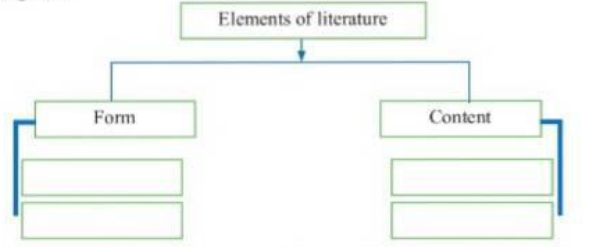
(c)Summarise the content of Text 1 and 2 in Activity 2(b) using the following diagram.
(d)With correct pronunciation, read and act out the following dialogue between Form Three students of Mtakufa Secondary School who were talking about their
Literature homework given by their subject teacher, and then answer the questions
that follow.
| Mori | Hi Mwami! |
| Mwani | Hi Mori. |
| Mori | I’m glad you’re here. How have you been doing? |
| Mwani | Not had. but busy as usual. Did you do the homework given last week by Mr Mwendokasi, our Literature teacher? |
| Mori | Do you mean the homework which was about figures of speech? |
| Mwani | Yes! |
| Mori | Oh yes, I did! I got a few definitions from the dictionary and some from the Internet. For example. I found on the Internet the word imagery as referring to a creation of mental image and sensory impression for emotional effect and intensity. It is the choice of words which make us see, hear, or even smell what is happening in the story. For example, when the writer says, “He hadn’t washed for a week so anyone coming near him was forced to hold his/her breath or his her nose.” This makes readers feel the smell of someone who hasn’t washed himself or herself for a week. Images also include figures of speech such as similes or metaphors. |
| Mwani | Yes. that’s what I too followed up on the Internet and in the dictionary. I found there were many figures of speech, for example, simile is one of the figures of speech in which two things that are essentially different are compared using conjunctions such as ‘like’ and as’. For example, ‘He is ns greedy as a hyena’, or ‘they all ran away like rats’. A metaphor is also a direct comparison between things but without using ‘like’ or ‘as’. For example, ‘Oh! My mother, you are angel of God’, or ‘the teacher roared with anger’. |
| Mori | Wow! You have really done your homework. Let me add. personification is a literary device in which nonhuman things or abstractions are represented with human attributes. For example, ‘Necessity is the mother of invention’ or ‘the car coughed and spluttered when lite engine was started.’ I also learnt dial hyperbole is an intentional and extreme exaggeration for emphasis or effect. For example. ‘Millions of people attended my birthday’ or ‘She received a bundle of kisses.’ |
| Mwani | I can see you have even more definitions than I do. |
| Mori | I am lucky. You see, my elder sister studied literature as one of her subjects in high school. I use most of her books for reference. |
| Mwani | Bravo! Good for you! I wish I had such resources too. |
| Mori | No problem. you’re a good friend of mine. I will be lending them lo you whenever you need them. Did you find out anymore terms? They are so many of them, my head is aching. |
| Mwani | Euphemism is one of the figures of speech we all use frequently. It is the use of polite expressions to replace words and phrases considered harsh or impolite and unpleasant. For example, ‘pass away’ for ‘die’, or ‘going to the washroom’ for ‘going to urinate’. Symbolism is the use of a word or a phrase to represent or stand for something larger than itself. For example, ‘dove’ symbolises ‘peace’ and heart symbolises ‘love’. |
| Mori | Enough my friend. Let me work on these first and then we can learn some more later. |
| Mwani | You are right. Let’s take a break. |
0 of 5 Questions completed
Questions:
You have already completed the quiz before. Hence you can not start it again.
Quiz is loading…
You must sign in or sign up to start the quiz.
You must first complete the following:
0 of 5 Questions answered correctly
Your time:
Time has elapsed
You have reached 0 of 0 point(s), (0)
Earned Point(s): 0 of 0, (0)
0 Essay(s) Pending (Possible Point(s): 0)
(a) Read and act out the following interview about what literature is between a TV presenter and a literature teacher from Mwembeni Secondary School
| Mr Mgimba |
Good evening ladies and gentlemen. Welcome to your favourite TV programme, “Shine in Literature.” Our today’s guest is Ms Tabia, a teacher of Literature from our nearby secondary school, Mwembeni Secondary School. Your host is none other than Mr Mgimba and you are watching your favourite Mzalendo TV. Welcome to our studios, Ms Tabia. |
| Ms Tabia | It’s my pleasure to be here. |
| Mr Mgimba |
Teacher, I know you have been in this field for a long time. Besides, you have written a couple of literary works which are nationally and internationally recognised. With such experience, what do you say literature is? |
| Ms Tabia | Before we get into literature, let me give you a general explanation. Ever since writers first appeared, they have been asking questions trying to make sense of the world around them. Many have left written records of their lives and ideas all of which we call literature. That is the first definition of literature all writing , in particular, writing that is worth reading. There is then a more narrow definition which refers to imaginative writing using artistic methods. Writers use their imagination to reflect on life in all its various shape forms. |
| Mr Mgimba |
Uh… um um…What exactly do you mean? |
| Ms Tabia | I mean that an imaginative art which expresses thoughts and feelings of the artist on events around him or her using language in an artistic way. It is a mirror in which audience can see themselves and a window through which they can explore the world around them. Writing becomes literature because of the power of what the writer wants to say; the power of the language she or he uses. |
| Mr Mgimba |
Thank you very much. So, what are the main forms of literature? |
| Ms Tabia | These can be divided into three main groups; novels and short stories; drama or plays; and poetry. All of them can either be fictitious or non-fictitious. |
| Mr Mgimba |
So, you, educated elites don’t recognise the art of our ancestors? |
| Ms Tabia | (laughs) Of course we do . We call that oral literature. |
| Mr Mgimba |
That’s great! Can you please tell the audience more about it? |
| Ms Tabia | Sure! Oral literature is the literature which is spoken. When it is put in written form, it changes its name to written literate. |
| Mr Mgimba |
Is that all? |
| Ms Tabia | No, oral literature is very rich, as it uses rituals, songs, epic poems and praise poems, folktales and legends as well as histories of people. All these are rich in language, including proverbs, riddles, sayings and a variety of figures of speech. These are supplemented by the way the oral teller or singer uses her or his voice and actions to add life to what is being said. |
| Mr Mgimba |
That’s interesting. I am sure my viewers would love to join literature classes. Can you tell more, please? |
| Ms Tabia | Well, oral literature is usually closely connected to a particular culture. It includes stories adapted to a particular context of that culture or community. |
| Mr Mgimba |
OK. I am glad to hear how much you value oral literature. But, back to written literature, namely novels and short stories; drama or plays and poetry. Are they aspects of literature? |
| Ms Tabia | Yes, these are referred to us genres of written literature. |
| Mr Mgimba |
So, could you kindly explain what each of these genres mean? |
| Ms Tabia | A novel is a very’ long story which usually has many different themes. Novels come out through characters and the way they interact with one another. Through the story and characters, the author expresses their point of view about different aspects of life. |
| Mr Mgimba |
What about short stories? |
| Ms Tabia | They are stories like novels, but they are much shorter. Since they are short, a number of short stories may be collected and put together in a book called an anthology. |
| Mr Mgimba |
What about drama? |
| Ms Tabia | Drama is literature which is acted on stage or in movies. |
| Mr Mgimba |
So. drama is a play. |
| Ms Tabia | In a way. yes. When it is acted before an audience, it is called drama but once it is written and read as a book, it is referred to as a play. |
| Mr Mgimba |
So, let’s come to the third genre. Mis Tabia, what is poetry? Il always seems so difficult to me. |
| Ms Tabia | (laughs)You are right. My students are the same. But we are afraid of poetry for nothing. Songs with meaning are poems. All we can say is that poems are ways of expressing a great deal in a short space of time, using rhythm to give more meaning We can categorise poetry into traditional and modem poetry. Traditional poetry refers to those poems that have regular rhyme and rhythm throughout the poem while modem poetry refers to those poems that do not follow regular rhyme and rhythm. In other words, poetry, like literary works, can tell a Story and can have characters as well. |
| Mr Mgimba |
Then, how can they be called poems? |
| Ms Tabia | It’s because of rhythm and the way the poem is divided info lines that help to add to the meaning of the poem and the feelings of the poet. But don’t be confused Sometimes, the person speaking in the poem is not the poet herself or himself. It is a character. For such poems, a character is called a persona, for example, the poet may be a man but the person speaking in the poem, the persona, is a woman. |
| Mr Mgimba |
Wow! Ms Tabia, you have given so much to think about. It is unfortunate that we are running out of time, but I would like you to finish up by explaining the importance of literature. |
| Ms Tabia | I think that needs another programme, but I will try. Literature is the best form of writing; so, when you read a novel or a play or a poem, you experience the life, culture, emotion, and deeds of a particular society. When you read literature, you travel Io a hundred of different places and meet a thousand different people without even moving from your chair. You feel what the writer or the characters feel, you learn from what they say and do, you get caught up in the story because you want to know what happens, and you enjoy yourself at the same time. I think it is true to say that when you finish reading a good piece of literature, you are changed somehow by all you have felt and experienced. |
| Mr Mgimba |
That is amazing. I can’t wait to go and read a new novel. I Thank you so much Ms Tabia and welcome again. Thank you too my audience. I am sure you have learnt a lot about literature. Goodbye for now. |
Questions
This response will be reviewed and graded after submission.
(b)Read Texts 1 and 2, then discuss in pairs or small groups the questions that follow after each text
Text 1:
Elements of literature
There are two elements of literature – form and content. Simply, content is what the writer wants to say while form is how he or she says it. For example, in a novel, the elements of form are, firstly, the setting. This is the context, physical and social environment in which the story takes place. It is both geographical (where) and historical (when). For example. “Hawa the Bus Driver’’ has its setting in Dar es Salaam in the 1980s when people were mainly using UDA for transport and the daladala system of transport was beginning to take part. Setting also refers to social environment. Is it a time of peace or war? What are the traditions and beliefs of that society and so forth. The second element is the plot. This is the way the story is put together, how one event lends to or causes another event how characters interact with one another and so on. At the heart of any plot, there must be a conflict of some kind as that is what makes us want to continue reading. We want to know how the conflict is resolved.
Conflict is always introduced at the beginning (exposition stage) and as the characters attempt to resolve the conflict, it becomes complicated and the plot thickens at each stage. Thus, the plot has the following stages or elements which arc also summarised in the following diagram.
(a) Exposition: This is where the writer or author introduces the characters and setting by providing their descriptions and background. It is when, the conflict is introduced as well.
(b) Rising action: This is built during the story and gets more exciting It is where conflict gels stronger and stronger. It is also where the suspense gets
stronger as we want to know how the conflict is resolved.
(c) Climax: This is the moment of greatest tension or excitement in the story. It is when the conflict reaches its highest point and begins to be resolved.
(d)Falling action: This happens as a result of climax and we know that the story will soon end. It is often very short.
(e) Denouncement (resolution): This is the stage where all the challenges and conflicts are resolved and the story ends.

The third element is the characters. These are the imaginary people, animals or objects the writer has created for the story. We learn about the characters in many ways; their names and appearance, their education and work, the way they dress and talk ,their ideas and their actions, the problems they face and the ways they deal with them and what they learn as the story continues. Characterisation refers to the author’s ability to create characters that are realistic and make us feel about them; to lave them, or hate them , support them or want them to fail. The way we feel about the character is another reason for us wanting to read the novel. The fourth element is language. This refers to words the writer chooses and uses in describing or in telling the story, and how the author uses different figures of speech to make the language more attractive. It also refers to dialogue; the way he or she makes the characters come alive by the way they talk. The fifth element is style of the writer. This refers to the way the writer put the whole text together, including the language used, characters and his or her own unique way of telling the story.
there are also other smaller elements of style such as title. The writer tries to choose the title which attracts readers lo read and say something about what they will find inside the book or poem
Questions
Text 2
Content, on the other hand, refers to what the writer is saying through his or her descriptions and characterisation. It contains four elements. The first element is theme. There is the main theme which is the central idea or issue portrayed by the piece of writing.
For example, in “Passed Like a Shadow,” the main theme is HIV and AIDS while in
“Unanswered cries.” the main theme is Female Genital Mutilation/Cutting (FGM/C). There
can also be sub-themes like the issues of how to bring up children in “Unanswered Cries ”.
The second element is conflict. As said above, conflict is the basis of the story. Without conflict there is no plot. There are many different kinds of conflicts. They include the following:
(a)Intrapersonal conflict (conflict inside a character, n dilemma the character faces,
conflict between their head and heart)
(b)Interpersonal conflict (conflict between characters It could be the main character
and another character or between two other characters)
(c)Social conflict (conflict between the character and society, or between groups in
society, war)
(d)Family conflict (conflict within the family)
(e)Cultural conflict (conflict between different cultures or between a character and the
culture, for example, Olabisi in ‘Unanswered Cries” goes against the culture of her
mother’s society )
(f)Political conflict (conflicts between political groups or parties, conflicts about different
ways of developing the country, etc ). For example, the conflict in the novel “Passed
Like a Shadow by Benard Mapalala includes the following:
i) Adyeri fell ashamed of himself as he listened to the song al school. This is an intrapersonal conflict. The same is true of Abooki after she was raped by John. She was affected psychologically because she lost her virginity even though it was not her fault.
ii) Interpersonal conflicts include the conflicts between Adyeri mid Amoti. This happens when Adyeri beats her, or between Adyeri and Birungi when she throws him out of the house, and the conflict between Vicky and Tusiime and Kunihira that happens when Vicky opposes the idea of sleeping with men to make money.
The third element of content is message. Message refers to the main point the writer wants to make, It comes out of the theme. Thus, in “Unanswered Cries”, the theme is FGM /C and the message is that different groups in society should meet to discuss how to deal
mutilation. The message is related to the Lesson which is what the reader learns from the novel. Usually, the lesson w ill be the same as the message but sometimes, the reader learns something completely different. The fifth element of content is philosophy. Philosophy is the way the writer sees life as expressed through the content of the given novel. Here the reader has to distinguish between the ideas of the characters and the ideas of the author.
Questions
This response will be reviewed and graded after submission.
(c)Summarise the content of Text 1 and 2 in Activity 2(b) using the following diagram.

This response will be reviewed and graded after submission.
(d)With correct pronunciation, read and act out the following dialogue between Form Three students of Mtakufa Secondary School who were talking about their Literature homework given by their subject teacher, and then answer the questions that follow.
| Mori | Hi Mwami! |
| Mwani | Hi Mori. |
| Mori | I’m glad you’re here. How have you been doing? |
| Mwani | Not had. but busy as usual. Did you do the homework given last week by Mr Mwendokasi, our Literature teacher? |
| Mori | Do you mean the homework which was about figures of speech? |
| Mwani | Yes! |
| Mori | Oh yes, I did! I got a few definitions from the dictionary and some from the Internet. For example. I found on the Internet the word imagery as referring to a creation of mental image and sensory impression for emotional effect and intensity. It is the choice of words which make us see, hear, or even smell what is happening in the story. For example, when the writer says, “He hadn’t washed for a week so anyone coming near him was forced to hold his/her breath or his her nose.” This makes readers feel the smell of someone who hasn’t washed himself or herself for a week. Images also include figures of speech such as similes or metaphors. |
| Mwani | Yes. that’s what I too followed up on the Internet and in the dictionary. I found there were many figures of speech, for example, simile is one of the figures of speech in which two things that are essentially different are compared using conjunctions such as ‘like’ and as’. For example, ‘He is ns greedy as a hyena’, or ‘they all ran away like rats’. A metaphor is also a direct comparison between things but without using ‘like’ or ‘as’. For example, ‘Oh! My mother, you are angel of God’, or ‘the teacher roared with anger’. |
| Mori | Wow! You have really done your homework. Let me add. personification is a literary device in which nonhuman things or abstractions are represented with human attributes. For example, ‘Necessity is the mother of invention’ or ‘the car coughed and spluttered when lite engine was started.’ I also learnt dial hyperbole is an intentional and extreme exaggeration for emphasis or effect. For example. ‘Millions of people attended my birthday’ or ‘She received a bundle of kisses.’ |
| Mwani | I can see you have even more definitions than I do. |
| Mori | I am lucky. You see, my elder sister studied literature as one of her subjects in high school. I use most of her books for reference. |
| Mwani | Bravo! Good for you! I wish I had such resources too. |
| Mori | No problem. you’re a good friend of mine. I will be lending them lo you whenever you need them. Did you find out anymore terms? They are so many of them, my head is aching. |
| Mwani | Euphemism is one of the figures of speech we all use frequently. It is the use of polite expressions to replace words and phrases considered harsh or impolite and unpleasant. For example, ‘pass away’ for ‘die’, or ‘going to the washroom’ for ‘going to urinate’. Symbolism is the use of a word or a phrase to represent or stand for something larger than itself. For example, ‘dove’ symbolises ‘peace’ and heart symbolises ‘love’. |
| Mori | Enough my friend. Let me work on these first and then we can learn some more later. |
| Mwani | You are right. Let’s take a break. |
Questions
This response will be reviewed and graded after submission.